Updated From May 29, 2023.
Keeping industrial equipment stable and long-lasting often depends on strong foundations. Heavy machinery, crucial for many industries, needs solid foundations to avoid expensive downtime and keep operations running smoothly. Over time, foundations can crack and move because of:
- Environment
- Regular use
- Misalignment
- Poor design
- Vibrations
- Equipment Failure
Choosing the right solution to fix these cracks and gaps is essential, especially between cement and epoxy grout. Ignoring foundation problems can result in expensive repairs, extended downtime, and even hazardous working conditions.This guide explains their differences. And helps you decide the best solution for repairing your heavy machinery foundations.
Types of Grout for Foundation Repair
The two most commonly used solutions for foundation repair are cement grout and epoxy grout. Each has its unique properties, advantages, and drawbacks.
Pros and Cons of Cement for Industrial Machinery Foundations
Advantages:
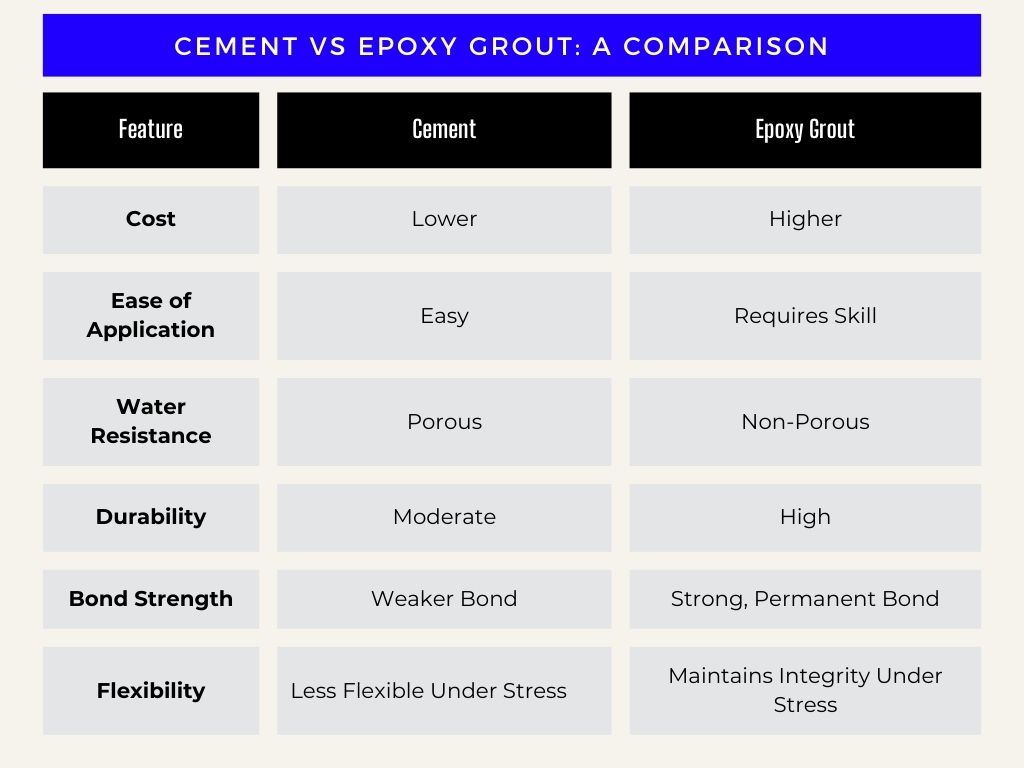
- Cost-Effective: Cement grout is generally cheaper than epoxy grout, making it an attractive option for budget-conscious projects.
- Easy to Work With: Its straightforward application process allows for quick repairs without the need for specialized equipment or extensive training.
- Temperature Versatility: Depending on the formula used, cement grout can be applied in both cold and hot temperatures.
- Flowability: Cement grout’s consistency allows it to flow into smaller cracks and voids more easily than epoxy grout.
Disadvantages:
- Porous Nature: Cement is porous and can absorb water, leading to potential further damage, especially in environments with high humidity or moisture.
- Limited Durability: It is less durable than epoxy grout and can crack or break over time, compromising the foundation’s stability.
- Vibration Sensitivity: Cement is not designed to withstand continuous impact loading and the vibrations generated by heavy machinery, which can lead to further damage.
- Chemical Susceptibility: It is vulnerable to chemical attacks from substances like oils, salts, and acids, which can degrade the grout and weaken the foundation.
Pros and Cons of Epoxy Grout for Industrial Machinery Foundations
Advantages:
- Non-Porous and Water-Resistant: Prevents moisture from damaging the foundation.
- High Durability: Resists cracking and breaking. This ensures long-lasting stability.
- Strong Bonding: Creates a permanent bond with concrete and maintains foundation integrity.
- Chemical Resistance: Protects against harmful industrial chemicals like oils and acids.
- Flexibility Under Stress: Remains intact even with vibrations and impacts from heavy machinery.
Disadvantages:
- Higher Cost: More expensive than cement grout.
- Complex Application: Requires skilled professionals for proper installation.
Case Study: Enhancing Stability with Epoxy Grout
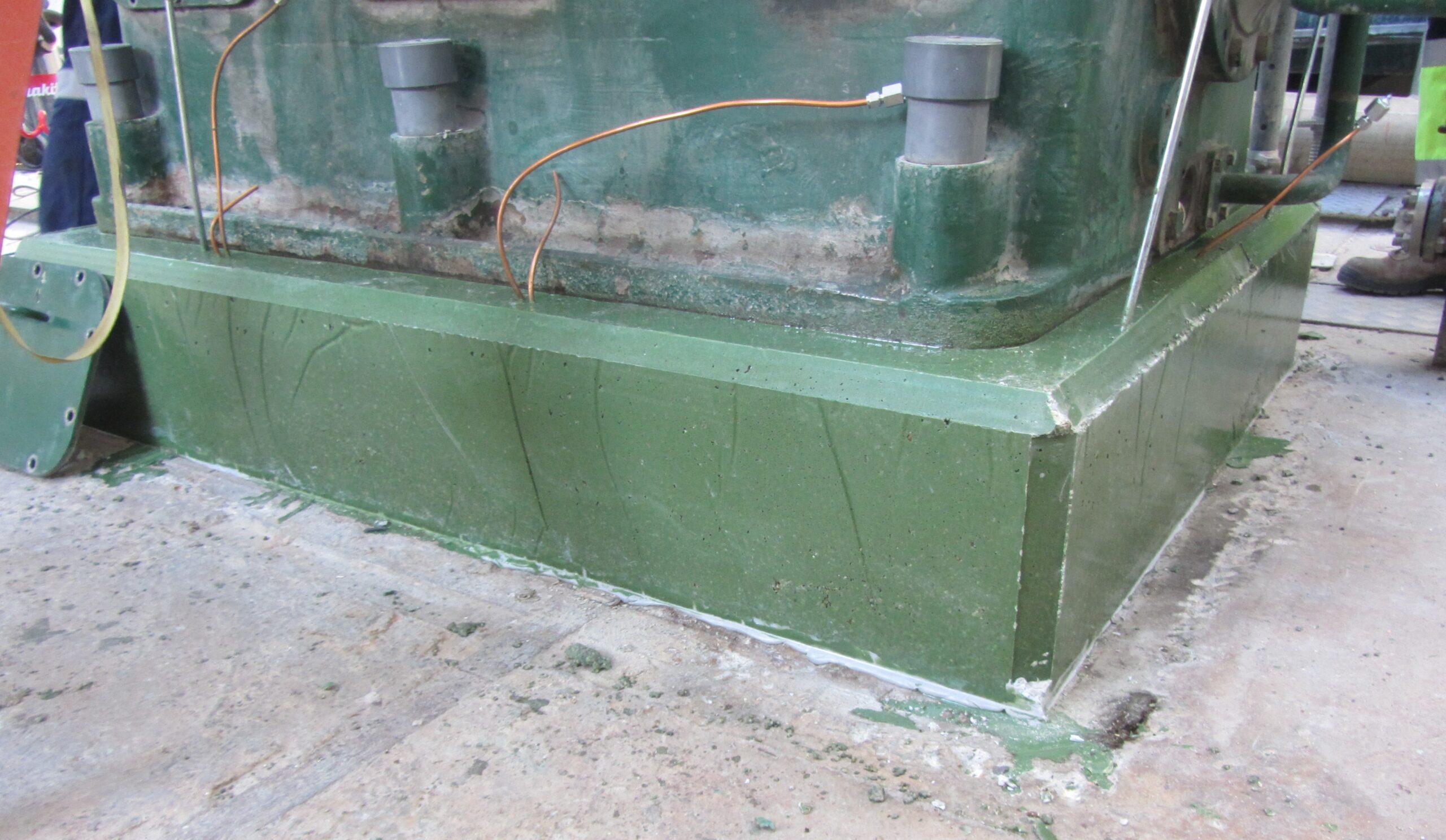
At the Andasol III Solar Power Station in Granada, Spain, HTF liquid tanks were cracking and becoming unstable due to temperature changes and fluctuating liquid levels, which damaged the anchoring and insulation systems. Alphatec Engineering responded by applying their ALPHATEC® 800 epoxy grout to reinforce the foundations and secure the sliding plates. This use of epoxy grout effectively restored the tanks’ stability, prevented further insulation damage, and ensured the reliable and efficient operation of the solar power station.
If you are specifying epoxy grout for a machinery foundation repair or new installation, contact the Alphatec Engineering team to discuss your project requirements.”
What is the Smart Choice?
For heavy machinery foundation repair, the advantages of epoxy grout are clear. Its non-porous nature, exceptional durability, strong bonding capabilities, and resistance to industrial chemicals make it ideal for maintaining stable and long-lasting foundations.
While cement may offer a cost-effective and easier application initially, it lacks the durability and resilience required for heavy machinery operations. Investing in epoxy grout not only protects your equipment but also minimizes costly downtime, ensuring reliable and efficient operations for years to come.
Frequently Asked Questions
What is the difference between epoxy grout and cement grout?
Epoxy grout is a two-component resin-based material offering high compressive strength, negligible shrinkage, and resistance to chemicals and dynamic loads. Cement grout is a cementitious material that is lower cost but prone to cracking, shrinkage, and degradation under vibration over time.
Which is stronger, epoxy grout or cement grout?
Epoxy grout is significantly stronger than cement grout. AT-800 epoxy grout achieves a compressive strength exceeding 80 MPa, compared to standard cementitious grouts which typically achieve 30 to 40 MPa. This makes epoxy grout the correct choice for heavy rotating equipment foundations.
Why does cement grout fail under rotating equipment?
Cement grout is not designed to withstand the continuous dynamic loads and vibrations generated by heavy rotating equipment. Over time it cracks, shrinks, and degrades, leading to foundation instability, equipment misalignment, and unplanned downtime.
Is epoxy grout resistant to oil and chemicals?
Yes. Epoxy grout offers high resistance to petroleum products, oils, acids, and alkalis, making it suitable for use in oil and gas, petrochemical, and refinery environments where chemical exposure is a regular occurrence.
When should cement grout be used instead of epoxy grout?
Cement grout may be appropriate for static, lightly loaded applications where dynamic forces are minimal and budget is the primary consideration. For any application involving rotating or reciprocating equipment, epoxy grout is the technically correct choice.
Does epoxy grout shrink after curing?
No. Epoxy grout has negligible shrinkage on cure, which is critical for maintaining precise machinery alignment. Cement grout shrinks as it cures, which can create voids beneath base plates and compromise foundation integrity over time.
Which grout does Alphatec Engineering recommend for industrial machinery foundations?
Alphatec recommends epoxy grout for all rotating and reciprocating equipment foundations. Alphatec’s proprietary AT-800 and AT-808 formulations are specifically engineered for heavy industrial applications, offering high compressive strength, chemical resistance, and long-term durability.
About Alphatec Engineering
At Alphatec Engineering, we specialize in innovative solutions for complex machinery foundation challenges. Our advanced epoxy resin-based grouts and hydraulic leveling systems ensure your foundations are restored to optimal condition, guaranteeing reliable and efficient operation of your heavy machinery.
What Our Clients Say
“We had encountered three significant instances of damage to the foundations of critical equipment, and local civil engineering companies had refused to intervene due to a lack of knowledge. However, Alphatec-Engineering was able to repair these foundations, despite their complexity, all in record time. And we did not require any follow-up visits. I highly recommend Alphatec-Engineering as they were committed, responsive, and efficiently completing the project. In short, they are a company of grouting professionals.”— Benjamin Pochot, Reliability Specialist, YARA France
If you’re seeking top-quality epoxy grout suppliers and expert foundation repair services, contact Alphatec Engineering today to discuss how we can support your industrial needs!